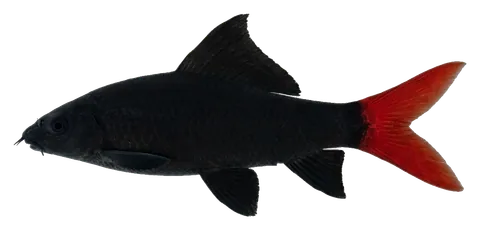
Red tail shark
Epalzeorhynchos bicolor
It takes over a cave and bursts out of it to drive off any intruders.
The Red tail shark (Epalzeorhynchos bicolor) is a tropical freshwater fish of the family Cyprinidae. It lives on the bottom. Adults grow to about 13 cm. The IUCN Red List rates it Critically Endangered. In the aquarium it needs a tank at least 120 cm long and water at 22–27 °C.
- Size
- 13 cm
- Smallest tank
- 120 cm
- Temperature
- 22–27 °C
- Care
- Moderate
In the aquarium
Temperature22–27 °C
pH6.5–7.8
Hardness4–16 °dGH
- Temperament
- Aggressive
- Diet
- Omnivore
- Activity
- Moderate
- Water layer
- Bottom
- Group
- Lives on its own
- Plants
- Plant safe
These values are compiled from real species data, and the LumaReef simulation is built to keep them true to life.
Which tank it fits
- Nano60 cm · 65 litresToo small
- Standard90 cm · 180 litresToo small
- Wide120 cm · 300 litres21 of them
- Living room180 cm · 650 litres46 of them
- Showcase250 cm · 1,200 litres85 of them
- Gallery300 cm · 1,440 litres102 of them
Who it lives with
Gets along28 species
- Swordtail
- Freshwater angelfish
- Dwarf gourami
- Betta (Siamese fighting fish)
- Black skirt tetra
- Diamond tetra
- Tiger barb
- Serpae tetra
- Yoyo loach
- Peacock cichlid
- Three spot gourami
- Convict cichlid
- Firemouth cichlid
- Julidochromis
- Rainbow shark
- African butterflyfish
- Yellow lab cichlid
- Red zebra cichlid
- Cockatoo cichlid
- Demasoni cichlid
- Severum
- Jack Dempsey
- Kissing gourami
- Multies shell dweller
Caution1 species
Narrow shared temperature range
Not together70 species
Aggressive with peaceful
- Bristlenose pleco
- Sailfin molly
- Giant danio
- Boesemani rainbowfish
- Scissortail rasbora
- Congo tetra
- Molly
- Gold barb
- Bronze corydoras
- Silver hatchetfish
- Pearl danio
- Dwarf chain loach
- Emperor tetra
- Zebra danio
- Cherry barb
- Platy
- Odessa barb
- Cardinal tetra
- Lemon tetra
- Penguin tetra
- Harlequin rasbora
- Black neon tetra
- Glowlight tetra
- Guppy
- Neon tetra
- Glowlight danio
- Green neon tetra
- Lambchop rasbora
- Endler's livebearer
- Galaxy rasbora
- Ember tetra
- Chili rasbora
- Green kubotai rasbora
- Koi
- Red rainbowfish
- Siamese algae eater
- Moonlight gourami
- Denison barb
- Pearl gourami
- Silver dollar
- Turquoise rainbowfish
- Keyhole cichlid
- Kribensis
- Kuhli loach
- Zebra loach
- Rosy barb
- Bolivian ram
- Celebes rainbowfish
- Checkerboard cichlid
- Neon dwarf rainbowfish
- Sterbai corydoras
- Hillstream loach
- Julii corydoras
- Rummynose tetra
- Threadfin rainbowfish
- Forktail blue-eye
- Panda corydoras
- Chocolate gourami
- Honey gourami
- Otocinclus
- Sparkling gourami
- Clown killifish
- Pygmy corydoras
- Clown loach
- Bala shark
- Common pleco
Water temperatures do not overlap
In the wild
- Water type
- Freshwater
- Climate zone
- Tropical
- Habitat
- On the bottom
- Aquarium trade
- Very common
Conservation status
Classification
- OrderCypriniformes
- FamilyCyprinidae
- GenusEpalzeorhynchos
- SpeciesEpalzeorhynchos bicolor
- Described bySmith, 1931
In other languages
- English
- Red-tailed Black Shark
- German
- Feuerschwanz-Fransenlipper
- Spanish
- Tiburón bicolor
- Russian
- Лабео двухцветный
- Japanese
- レッドテールブラックシャーク
Quick answers
- Red tail shark size: how big does it get?
- Adults reach about 13 cm. Record sizes among the 4 Epalzeorhynchos species on LumaReef: 9.3 cm (Redfin Shark) to 16 cm (Flying Fox Carp).
- Red tail shark tank size: what is the minimum?
- A tank at least 120 cm long. In LumaReef that is the Wide tank or larger.
- Red tail shark water parameters: what does it need?
- Temperature 22–27 °C, pH 6.5–7.8, hardness 4–16 °dGH. Close to what most Epalzeorhynchos on LumaReef need (20–26 °C).
- Red tail shark tank mates: what can it live with?
- It gets along with 28 of the 99 freshwater species in the catalogue, such as Swordtail, Freshwater angelfish, and Dwarf gourami.
- Red tail shark: alone or in a group?
- It can be kept on its own.
- Red tail shark and plants: is it plant safe?
- Yes, it leaves plants alone.
- Red tail shark: is it endangered?
- The IUCN Red List rates it Critically Endangered. Threatened among the 4 assessed Epalzeorhynchos species on LumaReef: 2.
Similar species
Sources
Red tail shark: compiled from these references.