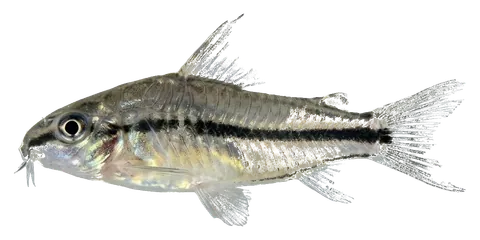
Pygmy corydoras
Corydoras pygmaeus
The odd cory out: not on the bottom but a shimmering mid-water cloud.
The Pygmy corydoras (Corydoras pygmaeus) is a tropical freshwater fish of the family Callichthyidae. It lives on the bottom. Adults grow to about 2.5 cm. In the aquarium it needs a tank at least 45 cm long and water at 22–26 °C.
- Size
- 2.5 cm
- Smallest tank
- 45 cm
- Temperature
- 22–26 °C
- Care
- Moderate
In the aquarium
Temperature22–26 °C
pH6.0–7.6
Hardness2–15 °dGH
- Temperament
- Peaceful
- Diet
- Omnivore
- Activity
- Moderate
- Water layer
- Mid water
- Group
- Happiest in a group of 10 or more
- Plants
- Plant safe
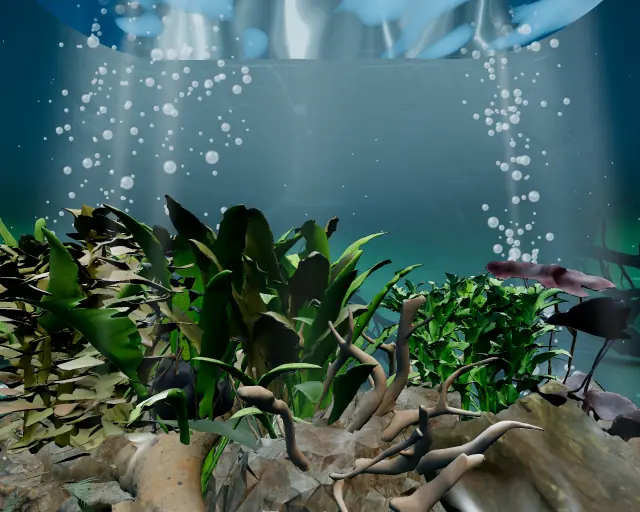
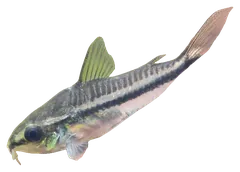
These values are compiled from real species data, and the LumaReef simulation is built to keep them true to life.
Which tank it fits
- Nano60 cm · 65 litres54 of them
- Standard90 cm · 180 litres150 of them
- Wide120 cm · 300 litres250 of them
- Living room180 cm · 650 litres541 of them
- Showcase250 cm · 1,200 litres1,000 of them
- Gallery300 cm · 1,440 litres1,200 of them
Who it lives with
Gets along62 species
- Galaxy rasbora
- Ember tetra
- Lambchop rasbora
- Green kubotai rasbora
- Endler's livebearer
- Neon tetra
- Glowlight danio
- Black neon tetra
- Serpae tetra
- Glowlight tetra
- Guppy
- Lemon tetra
- Penguin tetra
- Harlequin rasbora
- Odessa barb
- Emperor tetra
- Zebra danio
- Cherry barb
- Platy
- Dwarf chain loach
- Black skirt tetra
- Diamond tetra
- Silver hatchetfish
- Pearl danio
Caution25 species
Narrow shared temperature range
- Green neon tetra
- Chili rasbora
- Cardinal tetra
- Gold barb
- Boesemani rainbowfish
- Freshwater angelfish
- Koi
- Rummynose tetra
- Threadfin rainbowfish
- Sterbai corydoras
- Hillstream loach
- Checkerboard cichlid
- Cockatoo cichlid
- Rosy barb
- Kuhli loach
- Kribensis
- Pearl gourami
- African butterflyfish
- Red rainbowfish
- Moonlight gourami
- Severum
- Clown loach
- Frontosa
- Oscar
- Black ghost knifefish
Not together12 species
Aggressive with peaceful
Water temperatures do not overlap
In the wild
- Water type
- Freshwater
- Climate zone
- Tropical
- Habitat
- On the bottom
- Aquarium trade
- Traded commercially
Conservation status
Classification
- OrderSiluriformes
- FamilyCallichthyidae
- GenusCorydoras
- SpeciesCorydoras pygmaeus
- Described byKnaack, 1966
Quick answers
- Pygmy corydoras size: how big does it get?
- Adults reach about 2.5 cm. Record sizes among the 43 Corydoras species on LumaReef: 2 cm (Salt-and-pepper Catfish) to 7.5 cm (Bronze corydoras).
- Pygmy corydoras tank size: what is the minimum?
- A tank at least 45 cm long. In LumaReef that is the Nano tank or larger.
- Pygmy corydoras water parameters: what does it need?
- Temperature 22–26 °C, pH 6.0–7.6, hardness 2–15 °dGH. Close to what most Corydoras on LumaReef need (21–26 °C).
- Pygmy corydoras tank mates: what can it live with?
- It gets along with 62 of the 99 freshwater species in the catalogue, such as Galaxy rasbora, Ember tetra, and Lambchop rasbora.
- Pygmy corydoras: alone or in a group?
- Keep at least 10 together.
- Pygmy corydoras and plants: is it plant safe?
- Yes, it leaves plants alone.
Similar species
Sources
Pygmy corydoras: compiled from these references.