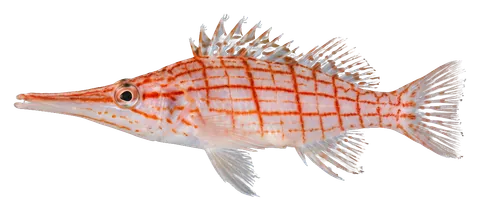
Longnose hawkfish
Oxycirrhites typus
It waits motionless atop a gorgonian, then takes its prey in one lunge.
The Longnose hawkfish (Oxycirrhites typus) is a tropical marine fish of the family Cirrhitidae. It lives on and around reefs, between 10 and 100 m deep. Adults grow to about 12 cm; the largest on record measured 13 cm (total length). In the aquarium it needs a tank at least 120 cm long and water at 23–27 °C.
- Size
- 12 cm
- Smallest tank
- 120 cm
- Temperature
- 23–27 °C
- Care
- Easy
In the aquarium
Temperature23–27 °C
pH7.8–8.5
- Temperament
- Semi-aggressive
- Diet
- Carnivore
- Activity
- Calm
- Water layer
- Mid water
- Group
- Lives on its own
- Coral
- Nips corals
These values are compiled from real species data, and the LumaReef simulation is built to keep them true to life.
Which tank it fits
- Nano60 cm · 65 litresToo small
- Standard90 cm · 180 litresToo small
- Wide120 cm · 300 litres23 of them
- Living room180 cm · 650 litres50 of them
- Showcase250 cm · 1,200 litres92 of them
- Gallery300 cm · 1,440 litres110 of them
Who it lives with
Gets along56 species
- Melanurus wrasse
- Exquisite fairy wrasse
- Lawnmower blenny
- Starry blenny
- Pearlscale butterflyfish
- Aiptasia-eating filefish
- Yellow coris wrasse
- Leopard wrasse
- Diamond watchman goby
- Domino damselfish
- Radiant wrasse
- Cleaner wrasse
- Bicolor blenny
- Lyretail anthias
- Yellowhead jawfish
- Maroon clownfish
- Pink skunk clownfish
- Flame wrasse
- Randall's shrimpgoby
- Dispar anthias
- Copperband butterflyfish
- Longnose butterflyfish
- Yellow watchman goby
- Fire goby
Caution43 species
Both semi-aggressive
- Tomato clownfish
- Lemonpeel angelfish
- Bicolor angelfish
- Scott's fairy wrasse
- Midas blenny
- Clarkii clownfish
- Valentini puffer
- Kole tang
- Flame angelfish
- Coral beauty angelfish
- Potter's angelfish
- Mystery wrasse
- Blackcap basslet
- Rusty angelfish
- Canary blenny
- Striped fang blenny
- Neon dottyback
- Bartlett's anthias
- Clownfish
- Flame hawkfish
- Orchid dottyback
- Banggai cardinalfish
- Percula clownfish
- Cherub angelfish
- Sixline wrasse
- Falco hawkfish
- Yellowtail damselfish
- Azure damselfish
- Yellow tang
- Scopas tang
- Convict tang
- Raccoon butterflyfish
- Dwarf lionfish
- Squarespot anthias
- Threadfin butterflyfish
- Engineer goby
- Sailfin tang
- Naso tang
- French angelfish
- Porcupine puffer
- Volitans lionfish
- Niger triggerfish
Narrow shared temperature range
In the wild
- Water type
- Marine
- Climate zone
- Tropical
- Habitat
- Coral and rocky reefs
- Largest on record
- 13 cmtotal length
- Aquarium trade
- Traded commercially
Depth
surface
10 m100 m
Conservation status
Classification
- OrderCentrarchiformes
- FamilyCirrhitidae
- GenusOxycirrhites
- SpeciesOxycirrhites typus
- Described byBleeker, 1857
In other languages
- German
- Langschnauzen-Korallenwächter
- Spanish
- halcón narigón
- French
- Poisson-faucon à long nez
- Dutch
- Spitssnuitkoraalklimmer
- Russian
- Оксициррит
- Japanese
- クダゴンベ
Quick answers
- Longnose hawkfish size: how big does it get?
- Adults reach about 12 cm. The largest on record measured 13 cm (total length). Record sizes among the 10 Cirrhitidae species on LumaReef: 8 cm (Falco hawkfish) to 30 cm (Stocky Hawkfish).
- Longnose hawkfish tank size: what is the minimum?
- A tank at least 120 cm long. In LumaReef that is the Wide tank or larger.
- Longnose hawkfish water parameters: what does it need?
- Temperature 23–27 °C, pH 7.8–8.5.
- Longnose hawkfish tank mates: what can it live with?
- It gets along with 56 of the 99 reef species in the catalogue, such as Melanurus wrasse, Exquisite fairy wrasse, and Lawnmower blenny.
- Longnose hawkfish: alone or in a group?
- It can be kept on its own.
- Longnose hawkfish and corals: is it reef safe?
- No, it may nip at corals.
- Longnose hawkfish depth: how deep does it live?
- In the wild, 10 to 100 m down. Deeper than most Cirrhitidae on LumaReef (1–40 m).
Similar species
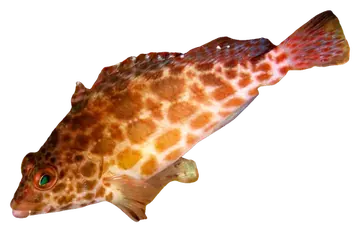 Threadfin HawkfishCirrhitichthys aprinus
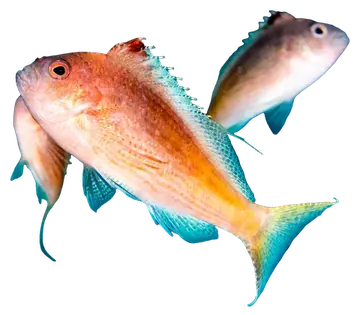 Lyretail HawkfishCyprinocirrhites polyactis
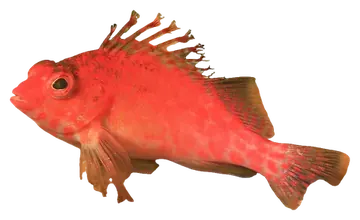 Pixy HawkfishCirrhitichthys oxycephalus
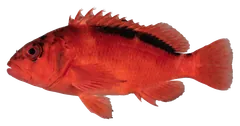 Flame hawkfishNeocirrhites armatus
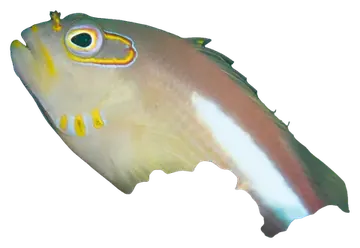 Arc-eye HawkfishParacirrhites arcatus
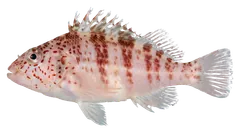 Falco hawkfishCirrhitichthys falco
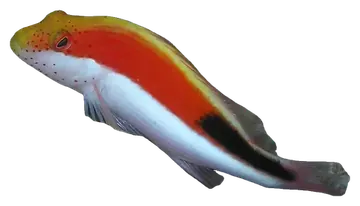 Freckled HawkfishParacirrhites forsteri
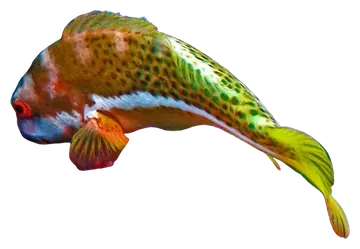 Ornate HawkfishParacirrhites hemistictus
Sources
Longnose hawkfish: compiled from these references.